
Lewis Carpenter, who made national news when he defeated an incumbent to become the first African American member of the Andalusia City Council, died Wednesday, May 27, 2020, at Mizell Memorial Hospital. He was 92.
Mr. Carpenter was born in Crenshaw County on February 1, 1928. He was the fourth of eight children, and grew up in the Bullock Community just outside of Brantley. When he was 21, he moved with his parents to Andalusia, he told The Star-News in a 2012 interview. His parents purchased a home on Lowe Avenue, and he also purchased land on Lowe Avenue, anticipating that he would also want a home there one day. He and his wife, Myrtice Bryant Carpenter, made their home there for 58 years until they moved to Opp Health and Rehab.
In 1952, Carpenter was “called into service.” In his two years in the military, he spent 18 months in the Korean Conflict.
In 1959, he joined Covington County Bank, and worked there in several roles over a 33-year career. He also worked as a reserve deputy with the Covington County Sheriff’s Office for many years.
In 1980, when the peace time armed services draft was reinstated, Lewis was in the first class appointed to the Selected Service Board. He served in that role for 20 years, retiring in 2001. He also was a poll worker for many years.
In 1984, he became the first African American elected to the Andalusia Council, and received many accolades during his three terms of service. His election gained nationwide attention, and his story was featured in Jetmagazine.
Carpenter was elected during at-large voting, meaning he had to run city-wide, and defeated a sitting council member to win his first term. Carpenter said he was encouraged to run by Mr. Will Coleman.
Jim Krudop was among those with whom Carpenter served on the city council.
“When I think of Lewis, I think of a very fine man, who was interested in Andalusia,” Krudop said. “He was always gentle, and had good, solid comments to make on how we could work together to make Andalusia better.”
Krudop said that it was in Carpenter’s first term that the council worked together to establish council districts, meaning council members no longer had to run for office city-wide.
In the 2012 interview, Carpenter said he was proud of several things accomplished during his council service, including improving sewerage treatment, increasing street paving, upgrading the police department, expanding the library and supervising the recreation department. He also appointed Andalusia’s first African American school board member, Sammy Glover, who currently holds an elected position on that board.
In June of 1999, Carpenter received an honorary associate of arts degree from Lurleen B. Wallace Junior College, and later served on the college’s advisory board.
Mr. Carpenter devoted his life to church, community and country. At a young age, he joined Jordan Grove Baptist Church in Searight, Ala., where he served as a deacon, church treasurer and in various other positions. In later years, he was a member of Grace Chapel Baptist Church in Andalusia, where he was an active member until his health failed.
He also was a member of Prince Hall Free and Accepted Masons of Alabama, with affiliations in the Rose of Sharon Lodge 196 and Del Rose Chapter 65, Order of the Royal Arch. He was always a kind and well-mannered gentleman.
His parents, H.D. Carpenter and Bessie Phillips Carpenter, and his seven siblings all preceded him in death.
His wife, Myrtice Bryant Carpenter, along with many nieces, nephews, extended family members and friends, will forever cherish his memory.
The U.S. Census Bureau announced this week that the 2020 Census field offices in Alabama would reopen this week.
As part of the phased restart of operations, the Census Bureau will resume the drop-off of 2020 Census invitation packets at front doors of households in areas where mail is received through P.O. Boxes. The Census Bureau began delivering census materials to these households on March 15; however, this operation was suspended March 18 due to the COVID-19 pandemic. As such, many of these households have yet to receive an invitation.
This process requires no face-to-face interaction, as Census workers will simply leave a packet of bagged information on doorsteps.Approximately 82,000 Alabama households are included in this process.
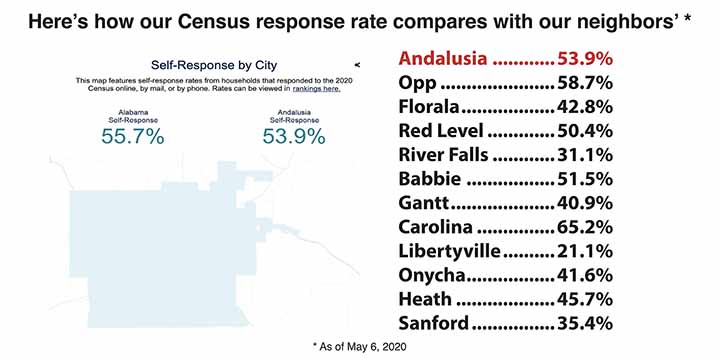
As of May 6, almost 56 percent of Alabama households had self-responded to the 2020 Census. In Covington County, only 50.6 percent of the estimated population has self-responded, and in Andalusia, that number is 53.9 percent.
Residents of the Carolina community have the highest self-response rate (65.2 percent), followed by Opp (58.7 percent). The fewest percentage of residents have reported from the Libertyville area (21.1 percent).
Residents may continue to self-report atwww.my2020census.gov, by calling toll-free at 1-844-330-2020 or by returning their paper forms.
The Census Bureau’s Alabama field offices are located in Mobile, Birmingham and Huntsville and cover operations for the entire state.
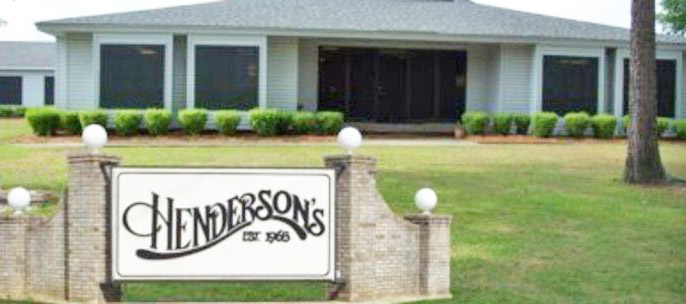
Before the rest of the United States even really began to worry about the possibility of a COVID-19 pandemic, Andalusia’s Frank Henderson, president and CEO at Henderson Sewing Machine Co., had a bit of a heads-up that a global crisis was coming.
Henderson, who often travels internationally for his business, said he got his first whiff of the trouble ahead in Japan in January. He was supposed to meet two friends in the Osaka airport, but they never called up. He called them.
“I learned that they were in quarantine for 14 days after coming back from China,” he said. “They told me what was transpiring in Wuhan, and what China was experiencing. So that immediately threw up a red flag for me. I returned home and told my team, ‘folks, there is something that might be coming here that we need to be prepared for.’ ”
Soon, he began receiving numerous queries such as “where can I find nonwoven fabrics?” and “how do I make masks?” so Henderson said he began to see his company’s role in the fight as a channel of information as well as a provider of equipment and systems for PPE production.
“We brought our staff together and said, ‘team, we all need to work now, but in order to do that, we need to be safe here,’ ” he said. “So everyone who walks into our building in the last four weeks has their temperature taken before they can enter. And they wear gloves and N95 masks. I have N95 masks because I have friends in the rest of the world who sent them to us. A local nursing home here in town had no masks, so we sent about 240 of them to help.”
As of mid-April, Henderson Sewing had placed 27 automated face mask systems in 14 states – from Maine to California, as well as in Canada – to produce face masks in a vertically integrated supply chain, starting with fabric through the folding process to ultrasonically cut, seal and attach to products that are packed either in singles or fives and 10s up to 20s for shipment, he said.
“We're already looking at Version 2 of those supply chains now in changing those systems to servos, steppers, drives and those kind of things to make them even more productive and efficient,” Henderson said.
Like his fellow speakers during a recent webinar hosted jointly by SEAMS, The Association & Voice of the U.S. Sewn Products Industry, and SPESA, The Sewn Products Equipment & Suppliers of the Americas, Henderson said he is putting in more time now than he ever has in order to answer the nation’s call.
“I haven’t worked very many seven days and seven nights over the last 45 years, but I certainly have over the last three or four weeks,” he said. “I’m on about 20 regular calls a day and six or seven conference calls a day.”
But the reward has been enormous as he sees a lifelong dream becoming a reality, he added.
“For us, it’s a joy to see our industry activated in a completely vertical supply chain here in America, with everybody working together the way we have been,” Henderson said. “Some of us have been waiting most of our lives to see this happen. For me it’s been 45 years – 45 years of seeing our industry gutted and decimated and shipped all over the world, to now being able to say these are essential items needed in America. These are essential items for the health and wellbeing of our people. And I hope our government will tune in to see that these products are just as essential as a military uniform or ammunition. Why aren't these items Berry compliant also? I think it's a question we all have to ask going forward.
“I think for each of us, it’s a new day, a new time, and it's an opportunity for each one of us to share, one with the other, and also I hope it’s an opportunity for us to build this vertical supply chain for things that some of us have waited a long, long time to see come back here to America,” he continued. “We can do that and we can compete with the rest of the world if we're equally yoked – not unequally yoked. But it's hard to do that if a government is subsidizing an industry and trying to push many of us out of business and out of the speed-to-market-type of scenario.”
Henderson’s story was reported by Devin Steel of TextileCommunications.com. Read the entire article, ‘It’s a new day, a new time,’ here.
The City of Andalusia this week began a "shop local" campaign which coincides with the reopening of most local retail businesses that were closed while Gov. Kay Ivey's pandemic "Stay at Home" order was in place.
That order expired at 5 p.m. on Thursday, April 30. As retailers opened their doors Friday morning, the City began pushing out a shop local message on local media.
"The COVID-19 pandemic has changed each of our lives in dramatic ways, many of which may have lasting effects," Mayor Earl Johnson said. "We don't know exactly what our future looks like, but we do know that we need to work together to rebuild the new normal for our community. Now is the perfect time to start."
The mayor took time Friday afternoon to visit with several local merchants who reopened on Friday. Each reported busy days with good traffic in their stores.
Local officials say they will continue to evaluate circumstances, but recreation programs must remain closed in Andalusia and all of Covington County for now.
“We understand that parents are anxious for recreation and other activities to resume,” Mayor Earl Johnson said. “But based on Governor Ivey’s order, and the state’s statistics, it is too soon to do so. The price we are paying now enhances our chances of being able to reopen schools in the fall, and to have the football, volleyball, band and cheerleading activities that we all love, especially in Andalusia.”
Gov. Kay Ivey on Tuesday announced her current stay-at-home order will expire at 5 p.m. on Thursday, April 30, and Alabama will remain under a safer-at-home order at least until May 15. While the new guidelines loosen restrictions on retail, they still limit gatherings to 10 or fewer with people required to remain at least six feet apart, and prohibit the reopening of close-contact businesses like salons and gyms. The new order also prohibits the reopening of athletic facilities and activities that require use of shared sporting apparatus or activities on playground equipment.
In anticipation of the governor’s new order, leaders of recreation leagues in Andalusia, Opp, Florala and Covington County met in person on Monday and by teleconference on Tuesday to discuss if and how baseball and softball seasons might be resumed. Participants included Andalusia Mayor Earl Johnson, Opp Mayor Becky Bracke, Florala Mayor Terry Holley and Covington County Commission Chairman Greg White, along with league officials Tommie Agee, Willie Edwards, and Jed Blackwell. A licensed physician also met with the group.
On Tuesday, Gov. Ivey and state health officer Dr. Scott Harris said the COVID-19 threat is not over.
“We’re still seeing the virus spread, and all our people are susceptible to the infection,” Ivey said Tuesday. “The great disservice to people who may be listening to me today is that lifting the comprehensive health restrictions (may lead them to believe) that there is no threat of COVID-19. We must continue to be vigilant."
The White House guidelines for “Opening Up America Again” call for a phased-in approach for reopening. The guidelines recommend that states begin to reopen after 14 days of declining numbers of new cases of COVID-19. Ivey stopped just short of implementing The White House’s Phase I reopening, which would allow sit-down dining in restaurants, and corporate worship, so long as social distancing was observed. The White House plan states that youth sports and other recreation not be reopened until Phase 2, which requires an additional 14 days of declining numbers of new cases, or 28 total days of declining numbers.
Local leaders said they will continue to monitor the situation, but a number of things must happen before any recreation programs can reopen. Those include future orders from the governor, as well as rates of COVID-19 cases and the availability to test for those cases.
Alabama’s State Parks, including Frank Jackson State Park in Opp, have remained open throughout the pandemic to encourage outdoor recreation. However, state parks closed playgrounds, beach areas, and dining operations.
The City of Florala closed access to Lake Jackson in April, but Mayor Holley said Tuesday he will reopen the lake this weekend. However, the pier and playgrounds will remain closed.